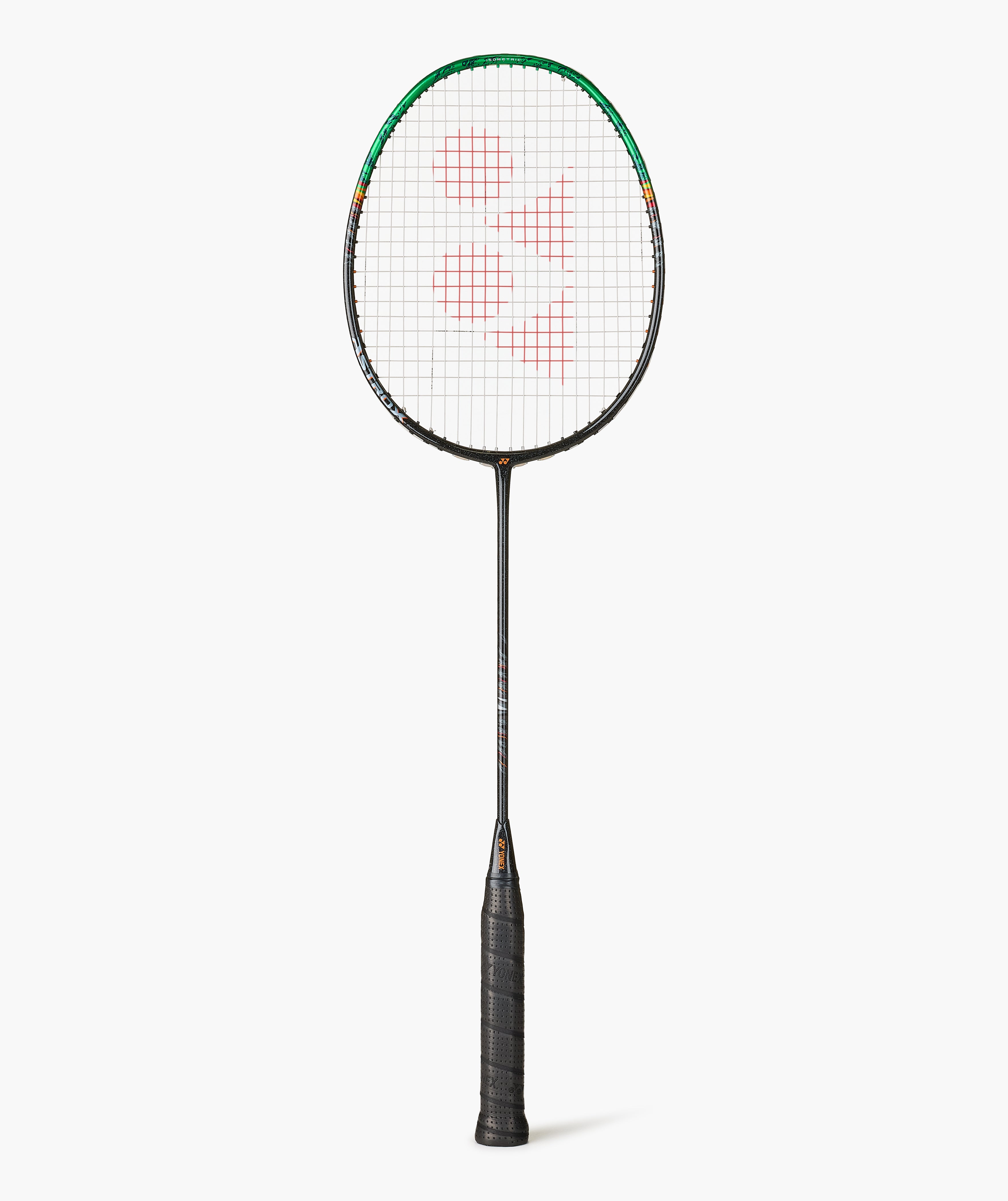
Astrox 99 Pro (2nd Gen)
Model AX-99PRO · Kento Momota, Kodai Naraoka
Price history
Not enough dated pre-owned sales yet for a price chart — our threshold is 3. 2 verified sales on record so far.
2 verified transactions on record · USD · methodology
Saw a sale? Report it →Where to find it
Search live eBay listings →Places to search for this racquet. We don't track stock, and listings and asking prices change fast, so check at the source.
Astrox 99 Pro (2nd gen): the redesign Yonex built with Kento Momota
Fixing the 99’s weight
Yonex introduced the second-generation Astrox 99 by naming the first one’s weakness. Announcing it in August 2021, it called the original a head-heavy power racquet with the heaviest swing weight in the Astrox series, one that produced a single powerful smash but was “often too heavy to be speedy in recovery.” It said it had worked hand in hand with Kento Momota, then the world No. 1, to keep that power while adding the ability to turn defense into attack. The racquet went on sale in late September 2021. On November 21 it carried Momota to the Indonesia Masters, his first World Tour title since the January 2020 car crash, a two-game win over Anders Antonsen.
Volume Cut Resin and the Power-Assist Bumper
Two additions carried the redesign. Volume Cut Resin, used through the whole frame, allowed finer weight distribution and wide-diameter string holes in the frame sides, which Yonex says let the strings move more and hold the shuttle longer. The Power-Assist Bumper, a tungsten-infused strip across the frame top, adds 55% more weight than conventional grommets by Yonex’s measurement and feeds the Rotational Generator System. The Pro alone got a squarer, thicker-sided Isometric head, the Extra Slim Shaft and the Energy Boost Cap Plus, with Namd in both frame and shaft. It was made in Japan and priced at ¥27,000 before tax. Yonex’s global site and 2024 catalog rate it stiff, like the first generation, though Yonex USA’s product page listed it as medium. Yonex advises 20–28 lb for 4U and 21–29 lb for 3U.
Momota, Naraoka and others
Yonex lists Momota on the 99 Pro from the October 2021 Denmark Open, where he lost a 93-minute final to Viktor Axelsen; his comeback matches earlier that year were on the first generation. He was runner-up to Axelsen again at the July 2022 Malaysia Open, and for his fifth national title, in December 2022, Yonex listed him on “ASTROX 99 PRO / ASTROX 77 PRO.” Its athlete page still showed the 99 Pro from 2023 into 2025, but no Yonex source names his racquet for the 2023 Korea Masters or the 2024 Thomas Cup, his last international event. Kodai Naraoka is the other well-documented user: Yonex lists him on it at his first Super 1000 final, the January 2023 Malaysia Open, for his 2023 world silver after a 109-minute final against Kunlavut Vitidsarn, and for the November 2023 China Masters, his first top-level World Tour title. Lee Zii Jia and Lu Guangzu also appear on it in Yonex’s lists.
Three generations, one name
The Astrox 99 name now covers three generations. The 2018 original (code AX99) came in Sunshine Orange, then Sapphire Navy, plus the green-and-purple LCW edition. The 2021 line (AX99-P for the Pro) came in White Tiger and Cherry Sunburst, and Yonex Japan said Momota would use the White Tiger Pro. White Tiger is a 2021 finish across the Pro, Tour, Game and Play, not a first-generation color. Yonex Japan sold the Pro and the Taiwan-made Game; the stiff Tour (AX99-T) and the graphite Play (AX99-PL) were sold elsewhere, and each has its own page. In early September 2025 the third-generation 99 Pro (3AX99-P, Black/Green) replaced it, with 2G-Namd Flex Force in frame and shaft and a lightened end cap Yonex says makes it its most head-heavy design. Alex Lanier won the 2026 world title on that racquet. Yonex’s list for his first big title, the 2024 Japan Open, prints only “ASTROX 99,” without a tier.
Four years in the range
The 2021 Astrox 99 Pro was standard production for about four years, from late September 2021 until the third generation replaced it in early September 2025, and Yonex Japan’s racquet list now shows only the newer code. For its whole run it was the only Astrox 99 Pro Yonex made, sold widely in two colors. The verified sales shown above are pre-owned 2021 frames from the Asian resale market, and only a few are recorded so far. What gives the model its interest is its record: a racquet designed with Momota that carried his first title after the crash, and Naraoka’s 2023 season. That record belongs to the model, not to any frame on the market.
White Tiger fakes and mixed listings
The 2021 finish is copied. In April 2026 a player’s blog compared a counterfeit White Tiger Astrox 99 Play with a genuine Cherry Sunburst one: the fake was a few millimeters longer, heavy and lopsided, with a slightly smaller, smudged logo and a hologram that looked solid where the genuine one is partly translucent. That was a Play rather than a Pro, but it shows the colorway itself is faked. Identity is the commoner trap. White Tiger and Cherry Sunburst cover all four 2021 tiers, the Pro name covers the 2021 and 2025 racquets, and listings can mix the AX99-P and 3AX99-P codes. Yonex adds that counterfeits are difficult to tell from genuine racquets by looking, and that privately bought racquets get no after-sales service. The callout lists the checks.
Built with Momota, replaced in 2025
The 2021 99 Pro sits between the Sunshine Orange original of Momota’s two world titles and the 2025 Black/Green Pro of Lanier’s 2026 world title. Its own story is the redesign: Yonex rebuilt its heaviest Astrox around one player’s need for faster recovery, and the result carried that player back to a World Tour title and took Naraoka to a world final. Some equipment lists move Momota to the 77 Pro for 2023–24, but Yonex’s record shows both racquets from late 2022, not a clean switch. Its successor kept the Power-Assist Bumper and the Pro, Tour, Game and Play tiers, and changed the materials and the balance; Yonex calls the 2025 racquet its most head-heavy design.
Confirm the generation first. The 2021 Pro is printed ASTROX 99 PRO, item code AX99-P, marked Made in Japan, in White Tiger or Cherry Sunburst. The 2021 Tour (AX99-T), Game (AX99-G) and Play (AX99-PL) share those colors, and Yonex Japan lists the Game as made in Taiwan. The first generation (2018, AX99) is Sunshine Orange, Sapphire Navy or the green-and-purple LCW; the 2025 third generation is Black/Green, code 3AX99-P. Yonex lists 3U (average 88 g, grips 4–6) and 4U (average 83 g, grips 5–6), 10 mm longer than standard, with Namd and Volume Cut Resin in the frame and Namd in the shaft. The tungsten Power-Assist Bumper across the frame top sets it apart from the first generation. Yonex’s own test is a hologram sticker that resists lifting with a fingernail.
The 2021 Astrox 99 Pro was standard production for about four years, so players can choose on condition, weight and grip. Ask for daylight photographs of the whole frame, the T-joint and the shaft markings, and check for the AX99-P code. White Tiger is the color Yonex assigned to Momota, but the Tour, Game and Play wear it too, and Yonex never tied a frame or a colorway to a match, so treat match-use claims as unproven without documentation.
Verified prices last updated Sep 2026. All data based on tracked secondary market transactions.