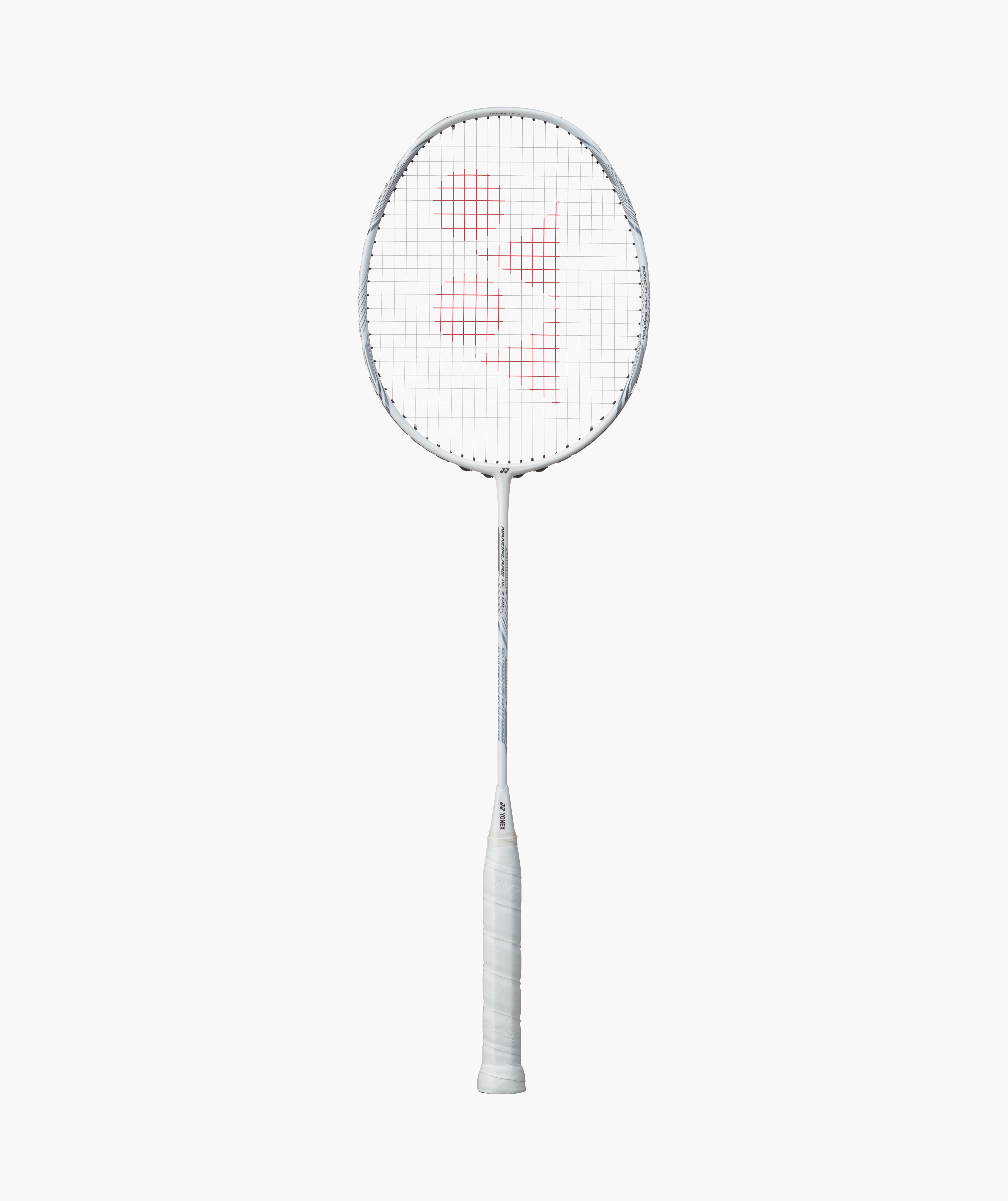
Nanoflare Nextage
Model NF-NEXTAGE
Price history
Chart: monthly median of verified pre-owned sales · USD · methodology
Saw a sale? Report it →Where to find it
Search live eBay listings →Places to search for this racquet. We don't track stock, and listings and asking prices change fast, so check at the source.
Nanoflare Nextage: the head-light half of Yonex’s soft-feel Nextage line
The head-light Nextage
Nanoflare racquets are known for fast repulsion, and Yonex’s release for the Nanoflare Nextage conceded that getting the most from them “can be demanding on the overall hitting sensation.” The Nextage was built to soften that. Yonex announced it on November 30, 2023 under the headline “Exhilarating Feel” and put it on sale on January 17, 2024, for intermediate players seeking more speed. It was the second Nextage racquet, presented as the head-light alternative to the head-heavy Astrox Nextage of 2023. Yonex defines the line as racquets with a comfortable feel at impact, named for players moving to the “Next Stage.” Both Nextage models reached Japan together in late December 2024.
HT Graphite and connected grommets
The racquet keeps the Nanoflare series’ Sonic Flare System, which Yonex built on high-modulus graphite at the tip of the frame and a strong, elastic graphite at the base. For the Nextage Yonex reworked it: high-elastic-modulus HT Graphite at the top of the head gives a soft feel at impact, and Connected Grommets at the bottom add shuttle repulsion. The series’ wide frame profile and sharp-edged aero shape reduce frame warp during the swing, keeping the racquet face stable. Yonex’s global page lists HT Graphite and Nanocell Neo in the frame and graphite in the shaft, with a built-in T-joint; the release adds the Energy Boost Cap Plus, and Yonex Japan a REXIS shaft that it says uses carbon equivalent to its top Pro models. Yonex Japan sums the racquet up as the series’ sharp speed shots with an exhilarating, distinctive feel.
For intermediates, not beginners
Yonex aims the Nanoflare Nextage at intermediate players. The global release says it is “tailored for intermediate players seeking increased speed”; Yonex USA calls it “built for intermediate to advanced players” and stresses swing speed and maneuverability; Yonex Japan’s level chart marks it intermediate only, for men and women, “for intermediate players who want speed and comfort.” No Yonex source calls it a beginner or junior racquet, and Yonex Japan’s 2026 catalog lists it beside the Nanoflare 70, 400, 300 and 111 without naming any of them the series’ starting point; the Nanoflare 70, a Japan-made Hi-Flex 4U rated best for intermediates, has its own page. No professional player is documented using it.
White and gray, then dark gray
Yonex makes one frame, item code NF-NT, in two colors. The launch finish is White/Gray (color code 103), which Yonex describes as a matte white base with sleek, streamlined patterns. Dark Gray (144) followed: Yonex’s global product page listed White/Gray alone in November 2024 and both colors by January 2025, and Yonex announced no date. There is one size, 4U (average 83 g) with a G5 grip. The Astrox Nextage, in black and green or light gray, is the line’s head-heavy partner with its own frame and technology; its page tells that model’s story.
Still in production
The Nanoflare Nextage is in production. Yonex’s global product page showed it in stock in October 2026, and Yonex Japan’s 2026 catalog carries it, so new frames sell at retail and resale is about pre-owned copies. Its US launch price was $150. Japanese listings often date it to December 2024; that is Yonex Japan’s domestic release, eleven months after the racquet went on sale elsewhere. The verified sales recorded so far all come from Asia resale and are all pre-owned; the price panel above lists them.
Copies and mix-ups
No counterfeit report specific to the Nanoflare Nextage has been found, and Yonex has published no guide for the model. Yonex’s general advice is to buy from a reliable retailer; it excludes racquets bought privately or without a confirmable purchase history from its after-sales service and quality guarantee. Within the family, the confusion to avoid is with the Astrox Nextage. Both are made in Taiwan in 4U with medium flex and share the Nextage name, so the series name and the colors tell them apart.
The second Nextage
The Nanoflare Nextage completed a two-model line that Yonex defines by comfortable feel at impact, and it is the line’s only head-light racquet. Yonex Japan’s 2026 catalog still lists just the two Nextage models. As a current standard racquet with no player link, it has no documented collector following; its interest lies in its place in the Nextage pair, a line Yonex pitched to players stepping up on the feel of the hit.
Yonex’s item code is NF-NT. The frame should be marked Made in Taiwan, and Yonex lists medium flex, a head-light balance, a single 4U size (average 83 g) with a G5 grip, a built-in T-joint and a frame 10 mm longer than standard. The documented colors are White/Gray (103), a matte white base, and Dark Gray (144). Yonex lists HT Graphite and Nanocell Neo in the frame and graphite in the shaft. A black-and-green or light gray frame with Astrox markings is the Astrox Nextage. Yonex’s own test is the hologram sticker, which resists peeling on a genuine racquet and lifts easily with a fingernail on a fake.
This is a current racquet, so most players will buy it new. Yonex recommends 20–28 lb and suggests Nanogy 95 for hard hitters and Skyarc for control players. On a used frame, confirm the NF-NT code, the Taiwan marking and the 4U label, and look for cracks at the head and the T-joint. A discontinuation, a limited color or a documented player would change its standing as a collectible; none has been announced.
Verified prices last updated Sep 2026. All data based on tracked secondary market transactions.